
“We Started Every Case as One Thoughtful Mind”: Corvinus Students at the CBS Case Competition
Between February 21 and 28, four undergraduate students from Corvinus University of Budapest competed at Copenhagen Business School’s prestigious international case competition, solving real business challenges under intense time pressure.
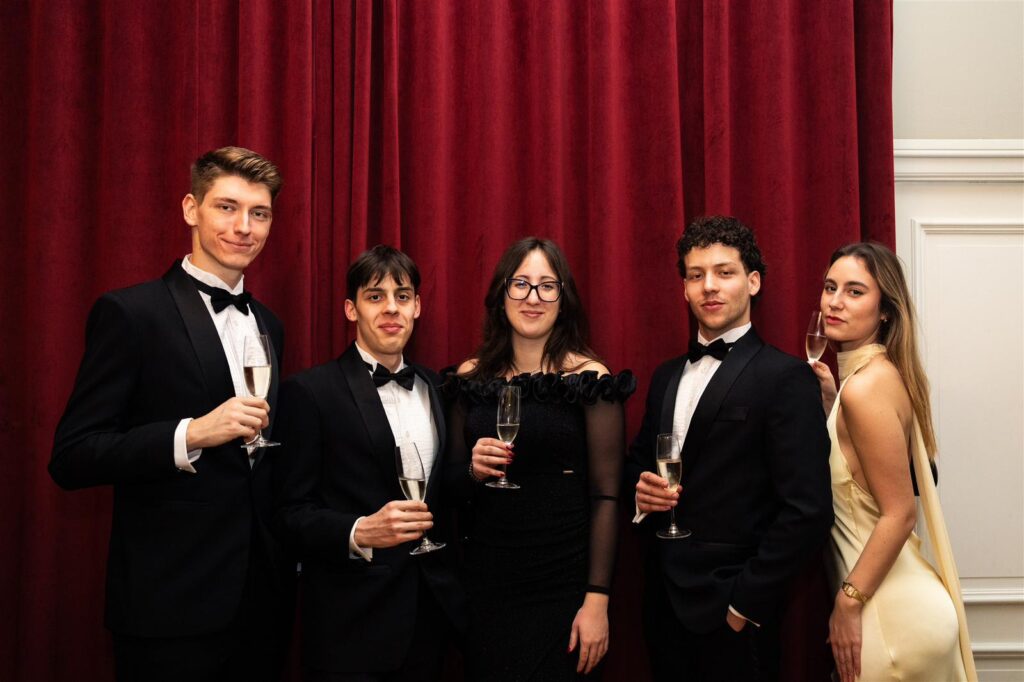
The undergraduate team of Anna Norina Steltzer, Róbert Tóth, Gergő Kelemen, and Levente Kiss delivered a strong performance, achieving 3rd place in their division in the 5-hour case and 4th place in their division in the 24-hour case. Their performance reflected both hard-earned preparation and the growing confidence of Corvinus’s international case-solving community. The team members had already successfully participated in international case competitions before, and the CBS Invitational was another important milestone in their case-solving journey.
The team was selected by their advisor, Miklós Attila Kozma, PhD, after successfully completing the Cases on International Business Strategy (CIBS) and Cases on Business Strategy (CBS) courses. They began preparing months earlier, developing a structured solving process, improving presentation skills, and building strong team coordination.
The competition was held fully offline and lasted for a week. Teams had 15 minutes to present their solutions for the 24-hour case, followed by a 10-minute Q&A session, while the 5-hour case included a 10-minute presentation and a 10-minute Q&A. The long case company, L’Oréal, was pre-issued one week before the competition, while the short case company, Flatpay, was revealed on-site.
The event also featured special elements to support teams during the solving process, including an auction where teams could bid for professional consultations and additional resources.
As Róbert Tóth explained: “One particularly unique element was the auction during the 24-hour case-solving period, where one member from each team participated in bidding for special rewards. For example, we managed to secure a short conversation with Bain consultants, another brief discussion with the case writers, 30 minutes of extra working time, and a 5-minute consultation with our advisor after submitting the case.”
The team prepared for months, solving diverse cases and participating in several workshops. Months of disciplined practice helped the team build focus and cohesion that showed strongly in Copenhagen.
“We put a lot of effort into preparing for the competition, and we already had our first preparation sessions back in November,” – Róbert Tóth said. – “In total, we had seven workshops, focusing on diverse topics such as creativity, executive communication, finance, and Danish business culture. In addition, we solved seven cases in total, three of which were in long format and four in short format.”
Communication and Q&A performance were also an important part of the preparation.
“Workshops were about executive communication (how to sell your ideas in a confident way), Q&A training (to improve answers, eliminating red flag phrases like I think) and industry research (numbers, trends about each industry),” Levente Kiss explained.
During the competition, teams worked on two different business problems. The short case focused on Flatpay and required teams to develop a market expansion strategy, while the 24-hour case, provided by L’Oréal, focused on targeting male consumers in the beauty market.
“One creative element of our solution was a proposed collaboration with Strava, a social fitness app, combined with a marketing campaign to reposition male beauty as part of functional wellbeing and emphasize that men can be just as proud of their skin as their strength,” Róbert Tóth explained.
Team dynamics played a crucial role throughout the competition. Strategy was always developed together, and tasks were divided only after the main direction was clear.
“Our team dynamics were on a different level, we started all cases together as one thoughtful mind and the idea execution was divided only to specific areas,” Levente Kiss said. “But we remained flexible throughout the whole time, helping each other out where it was possible.”
Roles were distributed according to each member’s strengths, with Gergő focusing primarily on finance, Anna on analysis and slide creation, and Róbert and Levente on strategy and implementation.
Their cooperation was especially visible during the Q&A sessions.
“During the Q&A, we were present like a football team, treating the questions like a ball that we could pass between each other in order to finally score a goal with the strength of the team,” Levente added.
Beyond the specific solutions, the competition also provided important professional lessons about time management, structuring work under pressure, and presenting a clear and convincing story.
“The most important thing we learned was how to use our short time under pressure most effectively to achieve the maximum impact in defending our solution,” Levente Kiss explained.
He also emphasized that strong solutions require teams to think from the company’s perspective:
“The case question itself gives an important direction, but a winning solution requires more than that. You need to step into the shoes of the company’s stakeholders, understand their needs, and think from their perspective as well as your own.” (Levente Kiss)
Reflecting on personal development, Anna Steltzer highlighted how the experience reshaped her way of thinking:
“Preparation and competition have taught me that case solving is essentially a never-ending story. I’ve realized that while it’s impossible to anticipate every single question, the process of practicing and defending my ideas has significantly broadened my perspective. I’ve learned that improvement isn’t just about finding the ‘right’ answer, but about developing the intellectual agility to ask the right questions. With every case, I find myself seeing a more complex, ‘big-picture’ view of the challenges at hand.”
Looking back on the experience, the team described the competition as both demanding and rewarding.
“Case solving is far from a simple task, in fact it requires lots of commitment and time to prepare for a competition,” said Levente Kiss. “But once you get there, it gives you a lifelong experience, both professionally and personally, shaping you in a way nothing else could.”
Beyond the professional challenge, the competition also included several social programs and opportunities to explore Copenhagen and meet students from around the world. Gergő Kelemen also emphasized the atmosphere and organization of the event:
“We had a pleasant time in Copenhagen, and it was very interesting and inspiring to see this being facilitated by a group of hard-working students! They had many scenarios figured out, knew when we needed more activities to keep us occupied or have some time to rest.”
Reflecting on the experience, faculty advisor Miklós Attila Kozma, PhD highlighted the significance of Corvinus’s participation:
“The CBS Case Competition is Europe’s most prestigious and longest-running event of its kind and being invited to participate is already a recognition of Corvinus’s more than fifteen years of dedicated work in case-based education. I was proud to see our students rise to the pressure, support one another like a true team, and earn praise even from fellow advisors who witnessed their presentations. Although we received no formal jury feedback, we analysed our performance against finalist teams and identified clear lessons that will help raise our game further. This determination to learn and serve our Case Track community is what sets Corvinus apart.”
Reflecting the university’s commitment to excellence in experiential learning, we would like to congratulate Anna, Levi, Robi and Gergő on their exceptional achievement, thank the CIBS and CBS course instructors and seniors of the Corvinus Case Track Community and especially extend our gratitude to their advisor, Miklós Kozma, PhD, for his dedicated support in the team’s preparation. Their performance demonstrates the strength of the Case Track programme, the growing international reputation of Corvinus case-solving teams, as well as the growth of the Corvinus Case Track Community (CCTC), the university’s primary community of strategy and case-solving enthusiasts.