
Strategic Thinking from Bangkok to Pattaya: How Corvinus Embraced Resilience and Storytelling at CIBCC
Four undergraduate students from Corvinus University of Budapest traveled to Thailand to represent our university at the prestigious Chulalongkorn International Business Case Competition (CIBCC). Facing a highly demanding and unique multi-city format, the team delivered strong, innovative solutions, ultimately securing a Divisional 4th place finish in both rounds.
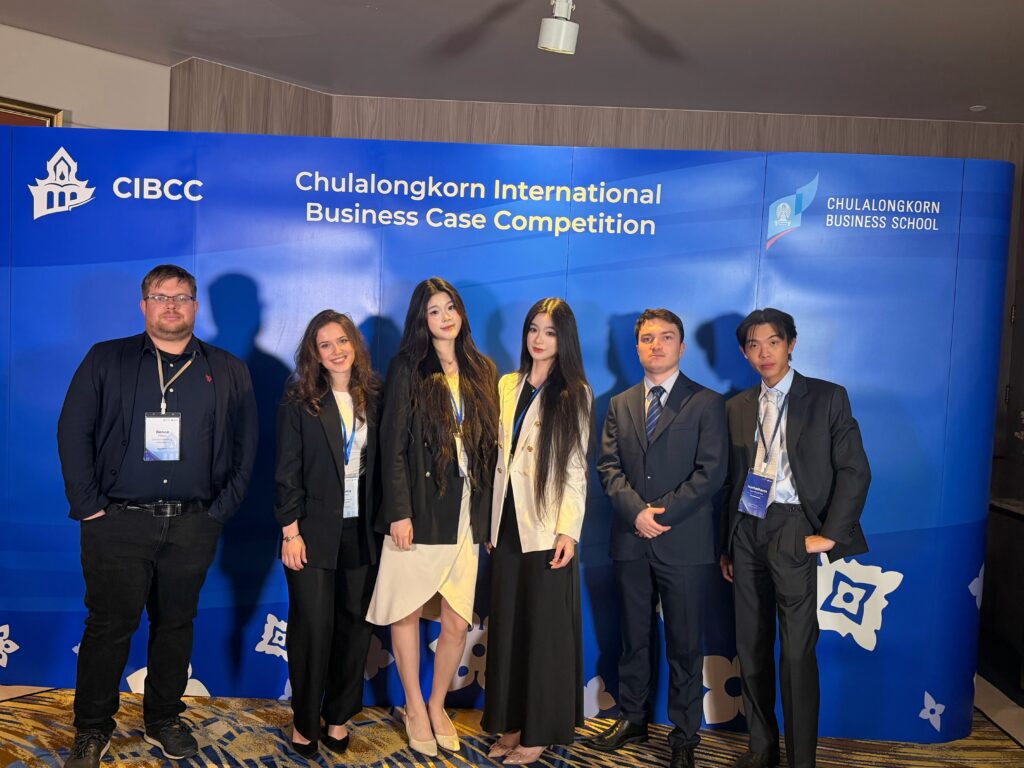
The 2026 edition of the Chulalongkorn International Business Case Competition (CIBCC) took place in Thailand between May 18th and May 24th. Four undergraduate students from Corvinus: Andrei Krajuhin, Annie Qin, Blanka Viktória Pásztor, and Suzie Shu, represented our university on the international stage. The team was selected based on their performance at Case Track courses and was mentored by Bence Pistrui, an active teacher and an advisor of the Case Track community.
Their intense preparation focused on specific presentation dynamics, an ESG workshop, and deep industry research to ensure they were ready to face global competition.
The competition tested the participants’ stamina through a geographical and operational shift, challenging them to stay sharp across different locations. As Annie Qin described:
“The competition had a unique format, with participants completing an 8-hour case round in Bangkok followed by a 24-hour case round in Pattaya, Chonburi. This multi-city structure made the competition particularly challenging and memorable, as teams had to adapt to different environments while maintaining performance over an extended period. The participating companies were announced one month in advance, allowing teams time to familiarize themselves with the industries and prepare before the competition.”
The 8-hour case focused on Noble, a prominent property development company, where teams needed to attract foreign investment despite strict domestic legal frameworks. Andrei Krajuhin explained the team’s strategic approach:
“The first case was about Noble, a propery developer – the question was how to engage the blue ocean of foreign investors, how to incentivise them into investing in Thai property. There were legal constraints on the share of foreign investors that can invest in a property etc. We came up with the solution to create tokenization for the properties, and sell them abroad that way, which gives flexibility in terms of amount to be invested and going through international borders.”
Immediately following this round, the team moved to Pattaya for the grueling 24-hour case regarding CPF, an end-to-end food manufacturer. To build a robust market entry strategy, the team recommended a focused expansion into Europe, targeting frozen convenience foods by establishing a central hub in Germany under the unified CPF umbrella brand to emphasize their end-to-end traceability.
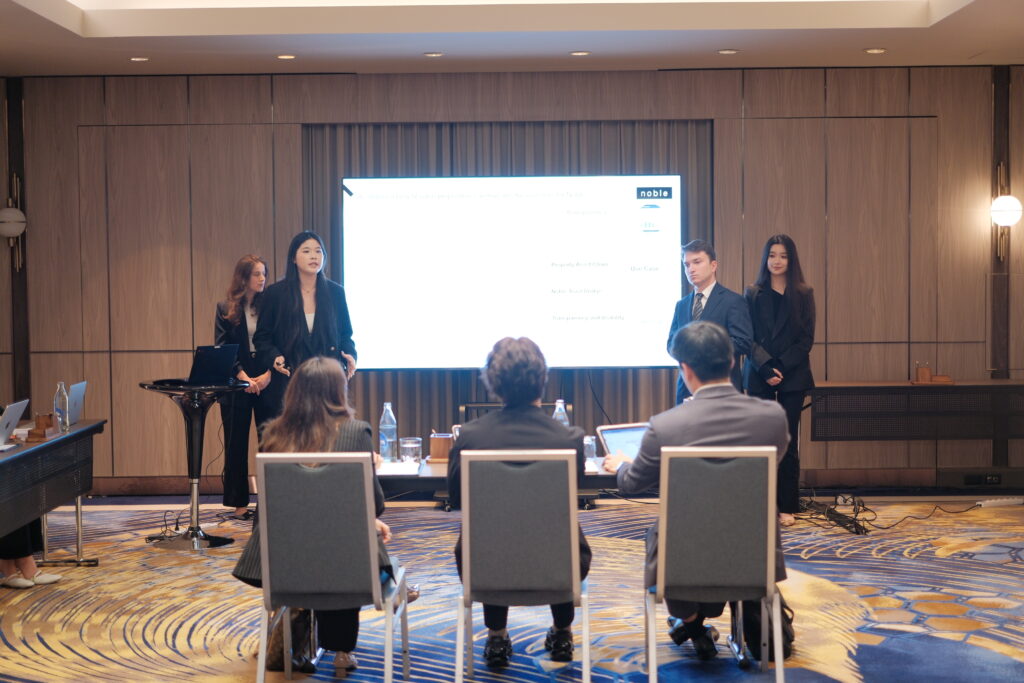
Beyond the numbers and legal constraints, the true strength of the Corvinus team lay in their outstanding group dynamics and mutual trust. Reflecting on how they operated under pressure, Annie Qin noted:
“Our team dynamic was one of the highlights of the entire experience. What surprised me most was not how well we worked together as competitors, but how naturally we connected as people. Each team member brought different strengths to the table—whether it was generating creative ideas, conducting detailed analysis, structuring recommendations, designing slides, or delivering presentations. Rather than operating in silos, we complemented one another and trusted each other to step up when needed. This allowed us to remain flexible and adapt quickly throughout the competition. We arrived as teammates, but we left as friends.”
This high-pressure environment also served as a catalyst for deep individual development. For Suzie Shu, the journey provided a fundamental realization about the core nature of business strategy:
“The most important thing I learned during the competition is that a strategy should not only be strong, logical, and feasible, but also appealing. A good solution may make sense on paper, but to truly convince others, it needs to tell a compelling story, connect with the audience, and make people believe in the vision behind it. This experience taught me that strategy is not just about analysis and numbers; it is also about communication, creativity, and empathy.”
While the ultimate aim is always the podium, the team walked away knowing that the true value of an international case competition lies in the journey, the intellectual debates, and the personal development along the way. For Suzie, CIBCC carried an extra emotional weight, serving as the perfect conclusion to her undergraduate case-solving career:
“This journey in Bangkok was especially meaningful to me because it marked my last international case competition, at least at the bachelor’s level. Ending my university life with my fourth competition feels both surreal and deeply fulfilling. Looking back, I truly believe this experience has been life-changing. Beyond the cases, presentations, and sleepless preparation, it gave me memories I will carry for a long time and friendships that made the journey even more special. More importantly, it taught me to stay open when things do not go as planned, to handle pressure with more calmness and confidence, and to approach strategy with a broader, more multi-faceted perspective.”
We would like to congratulate Andrei, Annie, Blanka, and Suzie, alongside their advisor Bence Pistrui, for their result, and dedication throughout CIBCC 2026. We also want to extend a huge thank you to the entire Corvinus Case Track Community seniors and professors for their continuous help, training, and support. We look forward to seeing how our community will build on these valuable insights in future international competitions!