
Strategic Visions in the City of Angels: Corvinus at the Marshall International Case Competition
Representing Corvinus University of Budapest, four dedicated students traveled to Los Angeles to compete in the prestigious MICC 2026. Facing unique presentation formats and world-class opponents, the team showcased exceptional strategic depth and adaptability on the global stage.

The 2026 Marshall International Case Competition (MICC), organized by the University of Southern California (USC) Marshall School of Business, saw four of our brightest undergraduate students represent Corvinus between February 17th and 22nd. The team consisted of Andrei Krajuhin, Réka Kristán, László Kruppa, and Emma Petrovicz, who were selected based on their outstanding performance in the Cases on International Business Strategy (CIBS) course. They were mentored and accompanied by their advisor, Dániel Kostyal, a PhD student at Corvinus and an active teacher and advisor of the Case Track community.
Preparation for MICC required a specialized approach, as the competition is famous for its „whiteboard” format. The team participated in targeted workshops focusing on for-profit dilemmas, IT, and Sales, while also researching potential industries and sponsors. A significant portion of their training was dedicated to mastering the art of the physical pitch and the „interrupted” presentation style.
“We worked incredibly hard on trying to figure out how to approach the three distinctive presentation formats. We tried to crack the code on how to ace the whiteboard and the interrupted presentation. For the whiteboard format, we managed to create a logical and easy–to–see–through visualization. With the interrupted format, the goal was to have a divisonal presentation with a flow that would fit the interrupted style too. Here we tried to put more emphasis on the pacing of the presentation, to reveal enough at the beginning to spark the jury’s interest.” — Emma Petrovicz
The competition featured two distinct cases in Los Angeles. The first was a 5-hour case with a unique twist: no slides allowed. The team had only a whiteboard and three markers to present their solution for Small Beer, a company deciding whether they should double down on the existing product or should they introduce a new line of product. A United States wide expansion was also asked from the competing teams. The Corvinus team developed a comprehensive „blueprint” for a rapid expansion into 20-25 states within two years, focusing on the company’s flagship product.
The second challenge was a 24-hour divisional round involving Warren James, a high-value merchandise producer for YouTubers and gamers. The task was to transition from campaign-based „drop” revenues to a stable cash flow through branded products. The team proposed an innovative solution:
„Our solution focused on accessories, specifically creative home decor targeting the gen Z trend for personalization and self-actualization, taking inspiration from the company MSCHF.”– as Emma Petrovicz mentioned.
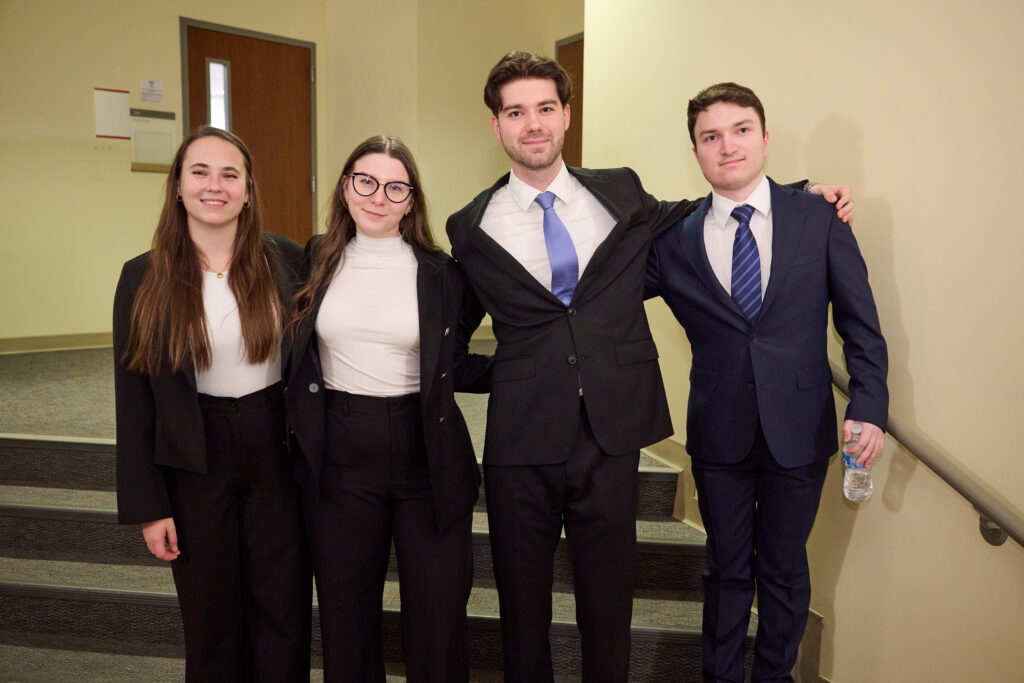
While the team faced an incredibly tough division, competing against the home team USC, Queens University, RSM, and Auckland, their performance was met with high praise from the industry experts, as Dániel Kostyal said:
“The jury highlighted the preparedness of the team and the clarity they brought to the presentation. At the 5-hour case, the CEO of Small Beer thanked the team for their insight on production capacity and praised the team for the detailed financial breakdown of the solution. At the 24-hour case, the jury highlighted the overall coherence and clarity of the team. They praised the introduction, storyline, analytical insights, and the financial implications. We went against the home team USC, Queens University, RSM and Auckland and were bested only by USC and Queens who became the eventual gold and silver medalists” — Dániel Kostyal
Beyond the strategic frameworks and financial models, the experience in Los Angeles served as a reminder of why case competitions are a cornerstone of the Case Track experience. It is about the growth that happens under pressure and the connections made across continents.
“To me, case solving is more than just an opportunity for professional development. The community it brings together, with the 24-hour solvings that may count as teambuilding if done right, to going across three different continents for competitions and seeing familiar faces at each, it truly gives you memories to share later on in life. I learned a lot, about who I am, performing under pressure, as a professional with each competition challenging what I thought I already knew about how business was done, to teamwork, working together with very different people and adapting my own working style to new teams” — Emma Petrovicz
The unique atmosphere of Southern California and the sheer scale of the event also left a lasting impression on the participants, reinforcing the significance of representing Corvinus at such a high-level global venue. As Andrei Krajuhin described the experience:
“Competing in Los Angeles has a different energy to it. The scale of the competition, the university campus, the teams we went up against — it was a proper international stage, and we wanted to make the most of it. We didn’t come home with a medal this time, but in the division, we went up against USC on their home turf and Queens, who then both took gold and silver in the final — that’s the level we were competing at. I’m proud of how we performed. LA itself was something else entirely. Beyond the cases themselves, being there, experiencing the city, meeting teams from across the world — it’s the kind of thing that stays with you.” — Andrei Krajuhin
From CCTC, we would like to congratulate the team members and their advisor, Dániel Kostyal, for their outstanding work! We also want to extend our appreciation for all the Case Track professors, advisors, and CCTC mentors for their efforts regarding the preparation for this competition. We are excited to see where our students will represent Corvinus in the near future